
Stanley LinkedIn
Company
Stan
Role
Product designer
Scope
- Research
- Product model
- Navigation architecture
- Shipped UI + front-end code
Background
Stanley is an AI content partner for LinkedIn creators. It learns your voice and helps you strategize, draft, and analyze posts so that even the busiest creators and entrepreneurs can publish more content in their voice, and reach more of their audience.
Problem
When I joined the team, creators said Stanley’s voice matching was far better than any other generic AI they’d tried.
But looking at their workflow, I noticed they kept turning to other tools to supplement Stanley: collecting ideas in Notes, editing initial drafts in Docs, scheduling directly on LinkedIn.
The goal was for Stanley to operate as a Head of Content, but Stanley was falling short because the chat didn't provide a durable enough surface for content work, and Stanley took no initiative.
Solution
To rebuild Stanley as a true Head of Content, I reimagined the product as a two-part system:
A hub that serves as a durable home where work is made visible and can compound
A guide that proactively engages Creators across channels they already use

Mapping Creator Workflows
To build a shared picture of how creators actually worked, I ran a 300-person survey and two tracks of 30-minute interviews.
Through the survey, we pinpointed creator’s biggest challenges and their desire for AI to help in overcoming them.
What 300 creators told us
To understand how effectively Stanley supports those jobs, and pinpoint where opportunities existed I also conducted 10 interviews with creators: five with non-users and five with Stanley creators.
Where Stanley supported creator workflows, and where it didn't
Stanley was helping creators think - building strategies, coming up with post ideas, and providing feedback on posts. But creators were left filling gaps: collecting post ideas in Notes, copying drafts into Google Docs, and scheduling posts on LinkedIn.
The Insight: System Gaps Over Feature Gaps
Strategizing, ideation, analysis, and posting all lived only in chat, making it hard for creators to discover what Stanley could do or build on their own progress.

The first iteration of Stanley left memory and motivation to the creator, and we lost direction, clarity, motivation, accountability, and learning.
The Head of Content Model
The reframe: stop treating Stanley as a chat box you operate, and build it like a Head of Content that sets direction and owns progress in a two-part system:
A hub that provides a durable surface to hold work, track progress, and compound learning over time
A guide that proactively engages across channels creators already use to create momentum and bring clarity in the moment
Designing the Hub
The Hub was the foundation the entire system would sit on, so we started there.
I restructured the navigation to reflect the steps in creators' existing workflows, making Stanley's existing capabilities clear.
Then I designed the connected, durable surfaces that made progress visible, including drafts (with a full-page editor), a redesigned calendar, and an analytics page, closing the gaps creators had been filling with Notes, Docs, and external scheduling tools.


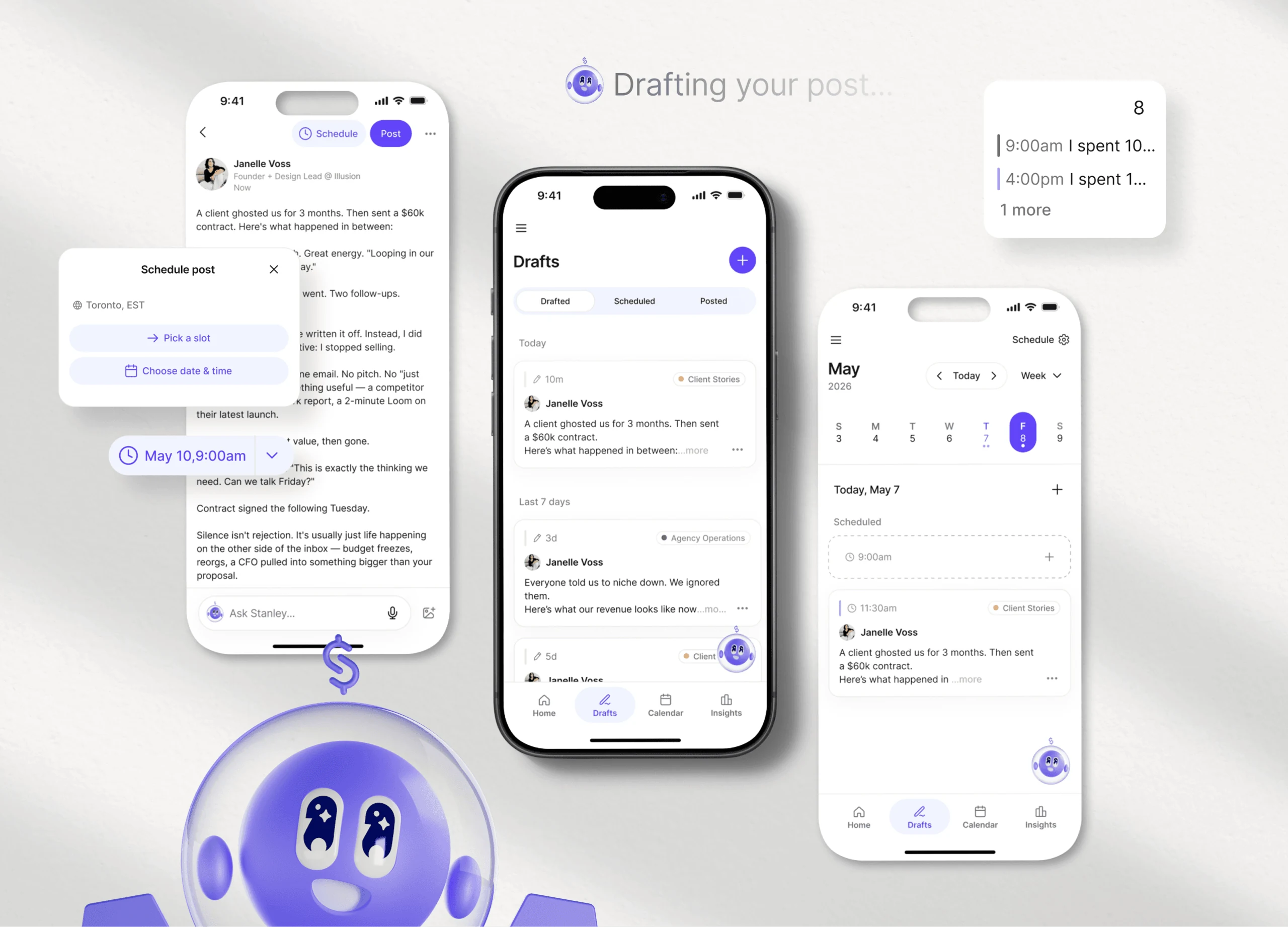
Building the Hub
I laid the front-end foundation, creating a token system and base components so every new surface was consistent and fast to assemble, then coded and shipped the app shell, the new navigation, the calendar redesign, and the full-page draft editor in the production React codebase.


The changes I designed and shipped became central to the product experience for our direct-to-consumer application and later set the foundation for the org/agency workspace restructure that followed for our Stanley for Business product. The guide is currently being built by the team, initiating content creation workflows through iMessage, Slack, and other spaces where creators spend time.
Credits
Karin Nord - design leadership
Thezyrie Amarouche & Yong Wang - engineering partners
Nick Hart - Stan DS foundations
Joe Lajavic - survey analysis
Cate Podell - participant recruitment and creator insights